May 27
/
Latest News
European Workplaces Reach Near‑Total AI Adoption as Data Exposure Risks Surge
European workplaces have woven generative AI so deeply into daily operations that nearly every organization now relies on it, according to new findings from the Netskope Threat Labs Report: Europe 2026.
AI features sit inside meeting transcription tools, writing assistants, coding copilots, search functions, and countless productivity apps, and employees routinely feed these systems customer records, financial data, and proprietary code. That widespread use has created a clear pattern in where data exposure is happening across the region.
AI adoption in Europe has reached near-total saturation, with about 99% of organizations using some form of AI and the share of individual workers actively interacting with AI tools jumping from 35% to 65% in the past year. Direct chatbot use is only part of the picture. Netskope’s data shows that 95% of users now engage with applications that include embedded AI features, often without realizing it, and 89% use applications that rely on user data for model training.
Companies have tried to rein in this activity by shifting employees into sanctioned environments. Personal AI account usage has dropped from 79% to 43%, while organization-managed AI solutions have risen from 28% to 72%. Even so, shadow AI persists, with the number of users switching between personal and enterprise accounts climbing from 7% to 15%.
AI features sit inside meeting transcription tools, writing assistants, coding copilots, search functions, and countless productivity apps, and employees routinely feed these systems customer records, financial data, and proprietary code. That widespread use has created a clear pattern in where data exposure is happening across the region.
AI adoption in Europe has reached near-total saturation, with about 99% of organizations using some form of AI and the share of individual workers actively interacting with AI tools jumping from 35% to 65% in the past year. Direct chatbot use is only part of the picture. Netskope’s data shows that 95% of users now engage with applications that include embedded AI features, often without realizing it, and 89% use applications that rely on user data for model training.
Companies have tried to rein in this activity by shifting employees into sanctioned environments. Personal AI account usage has dropped from 79% to 43%, while organization-managed AI solutions have risen from 28% to 72%. Even so, shadow AI persists, with the number of users switching between personal and enterprise accounts climbing from 7% to 15%.
The report shows that regulated data dominates exposure incidents, accounting for 59% of all policy violations across AI and personal cloud applications. Source code makes up 15%, intellectual property 13%, and passwords and API keys 12%. The trend suggests that compliance-sensitive information is the material most frequently pushed into AI tools or personal cloud accounts in ways that trigger data loss prevention controls.
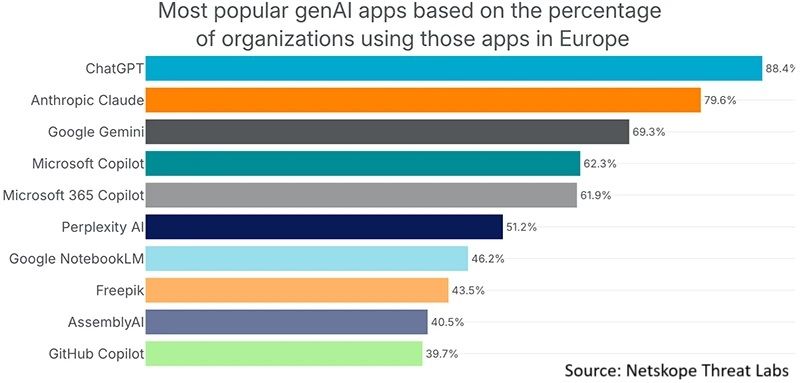
Europe’s preferred AI tools also diverge from global patterns. ChatGPT remains the most widely used service in the region, with Anthropic’s Claude taking second place ahead of Google Gemini. That ranking reverses the global order, where Gemini typically sits above Claude. Mistral’s Le Chat, developed in France, also appears prominently in European usage. Claude’s adoption surged in September 2025, when its growth curve steepened and pushed it past Gemini. ChatGPT maintained its lead throughout the year, and Microsoft Copilot held steady across the region.
Organizations are also blocking certain AI applications over privacy and data-handling concerns. Particular Audience tops the blocked list at 44%, followed by ZeroGPT at 37% and DeepSeek at 36%. These restrictions reflect unease around how some services process, personalize, and retain user data. In heavily regulated industries, companies often apply broad category-level blocks in addition to targeting specific apps.
The report highlights that attackers are increasingly blending into trusted cloud ecosystems. Malware distribution in Europe frequently relies on reputable platforms such as GitHub and Microsoft OneDrive, which benefit from user trust and can slip past URL-based filtering. The widespread use of personal cloud applications inside corporate networks further complicates security, as employees move files between personal and work environments, creating additional opportunities for exposure.
Netskope’s analysis suggests that European organizations have made significant progress in building guardrails around AI, particularly by shifting users away from personal accounts and into managed platforms. The remaining challenges center on the 15% of workers who still toggle between personal and enterprise AI accounts, the AI features embedded in everyday tools that operate outside the visibility of many security programs, and the steady flow of malicious files arriving through trusted cloud services.
The report recommends pairing data loss prevention controls with application-specific governance, noting that regulated data violations now span both AI tools and personal cloud applications, and that the boundary between these categories continues to blur as AI becomes a default layer in modern productivity software.
Europe’s preferred AI tools also diverge from global patterns. ChatGPT remains the most widely used service in the region, with Anthropic’s Claude taking second place ahead of Google Gemini. That ranking reverses the global order, where Gemini typically sits above Claude. Mistral’s Le Chat, developed in France, also appears prominently in European usage. Claude’s adoption surged in September 2025, when its growth curve steepened and pushed it past Gemini. ChatGPT maintained its lead throughout the year, and Microsoft Copilot held steady across the region.
Organizations are also blocking certain AI applications over privacy and data-handling concerns. Particular Audience tops the blocked list at 44%, followed by ZeroGPT at 37% and DeepSeek at 36%. These restrictions reflect unease around how some services process, personalize, and retain user data. In heavily regulated industries, companies often apply broad category-level blocks in addition to targeting specific apps.
The report highlights that attackers are increasingly blending into trusted cloud ecosystems. Malware distribution in Europe frequently relies on reputable platforms such as GitHub and Microsoft OneDrive, which benefit from user trust and can slip past URL-based filtering. The widespread use of personal cloud applications inside corporate networks further complicates security, as employees move files between personal and work environments, creating additional opportunities for exposure.
Netskope’s analysis suggests that European organizations have made significant progress in building guardrails around AI, particularly by shifting users away from personal accounts and into managed platforms. The remaining challenges center on the 15% of workers who still toggle between personal and enterprise AI accounts, the AI features embedded in everyday tools that operate outside the visibility of many security programs, and the steady flow of malicious files arriving through trusted cloud services.
The report recommends pairing data loss prevention controls with application-specific governance, noting that regulated data violations now span both AI tools and personal cloud applications, and that the boundary between these categories continues to blur as AI becomes a default layer in modern productivity software.
Executive IT Forums, Inc.
Educational Programs on Information Technology, Governance, Risk Management, & Compliance (GRC).

Our Newsletter
Get regular updates on CPE programs, news, and more.
Thank you!
Copyright © 2026 Executive IT Forums, Inc. All Rights Reserved.
Get started
Let us introduce our school
Write your awesome label here.